
When I watch an accomplished chef stir-frying, I see a magician, a worker of wonders. A chef may be battle-scarred, chain-smoking, inarticulate – and yet the grace and beauty of his movements, his extraordinary mental and physical agility, makes me gasp.
The careful selection of ingredients and balletic performance of perfect control over fire and steel, artfully combining ingredients into a whole greater than the sum of its parts may be found in wok cookery, but it is, unfortunately, not a property shared by Fuchsia Dunlop's 2023 Chinese food history and culture book Invitation to a Banquet: The Story of Chinese Food. Written and published during the heights of zero-COVID travel restrictions, when she could not visit China, the book feels like it is cobbled together out of the scraps of Dunlop's notebooks.
She celebrates the art of menu selection when eating Chinese food and explains how Chinese gourmets often find Western menus "‘very simple and very monotonous’ (hěn jiǎndān, hěn dāndiào)", yet her book repeats anecdotes about Chinese poet Qu Yuan's 3rd century poem 'Great Summons' in seven different chapters. The poem's description of a bereaved character's attempts to summon back a departed loved one with a mouth-watering meal makes a useful metaphor in a book about food, but the repetition that might be reasonable in a set of unrelated columns results in the kind of "lopsided menu" that Dunlop decries for an eater. I wish she had shown such concern for her readers.
China is a country of over a billion people with fifty-five officially recognized minority groups (which surely, Seeing Like a State style, flattens an even larger diversity). In a recent video the YouTube Chinese food channel Chinese Cooking Demystified catalogues sixty three different regional cuisine styles. There are Buddhist ethical vegetarians and Muslim populations that eschew China's most beloved porcine animal protein. Famously, Chinese cuisine has stitched together a northern wheat and millet staple grain society of noodle and dumpling eaters with a southern rice eating culture. Perhaps asking for a central thesis in a book about Chinese food is a fool's errand.
Dunlop occasionally tries to reach for one but seems to contradict her own argument as often as she strengthens it. "To be Chinese is to eat food that has been transfigured and transformed, first by the knife and then by the fire", she tells us, expressing a Chinese preference away from the primal steaks, raw sushi, or whole lobsters that Western eaters count among their most beloved foods and pay large sums for. Yet later we learn about kuài, a Chinese dish of raw sliced fish that is considered an ancestor of modern Japanese sushi. Dunlop celebrates the Cantonese whole steamed fish, "in the kitchen, the steamer awaits. If you have a perfect fish, what else would you want to do with it?". In the chapter about the importance of stocks and soups we are told of "a whole genre of Chinese dishes that attempts to present, without interference, the ‘root tastes’ of fine ingredients", and it's hard not to feel confused. In a land as large as China and a cuisine as varied as their food, there is certainly room for both ingredients served "without interference" and dishes served "transfigured and transformed", but all of this fails to create a through line that draws these essays into a cohesive whole.
As author Lu Wenfu argues so vividly, extreme political ideology tends to fail when it tries to forge a perfect society with new individuals purged of vice and weakness. In the same way, it is futile to deny our physical appetites, because we have not only minds but stomachs. We all must eat and love. As Gaozi said, shí sè xìng yě: ‘Appetite for food and sex is human nature.’
In her conclusion, Dunlop urges us to think of the universality of food. Yet, throughout the book, she indulges in frequently remarked on habit of every culture to believe they invented enjoying food.
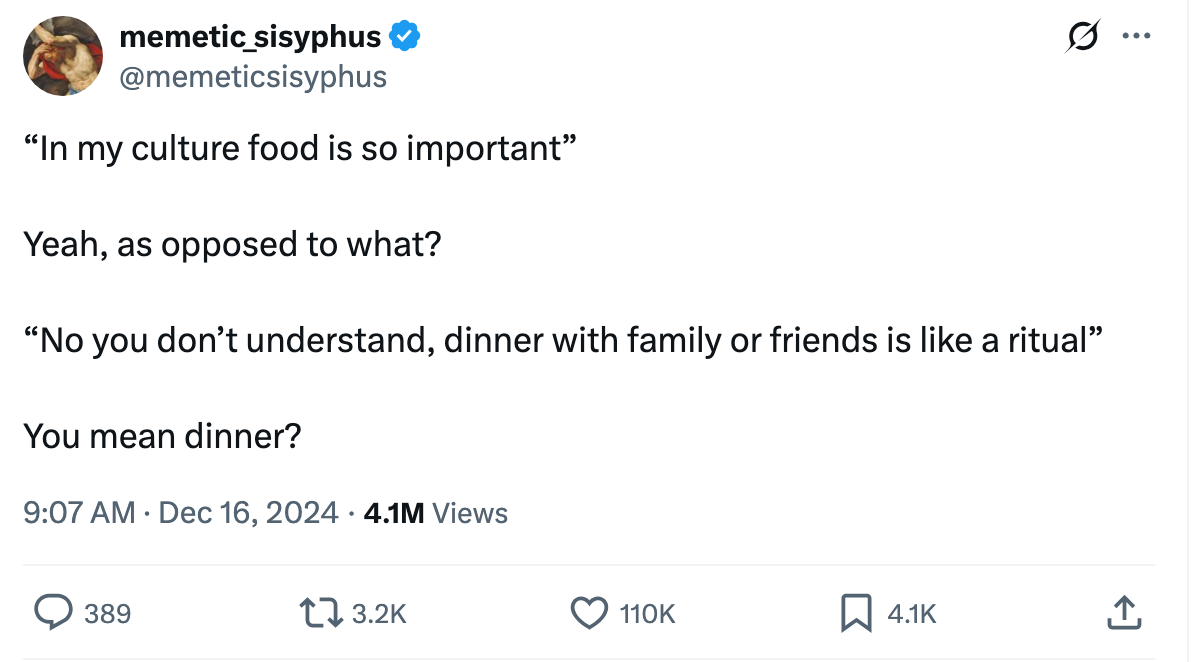
In Dunlop's chapter about "dietary therapy" she attempts to show how the Chinese have a uniquely medicinal view of food; yet every person who has eaten chicken noodle soup to cure a cold or lived through a health food craze knows all cultures are packed with traditional food remedies and rife with obsessions for the currently in vogue ingredients that are sure to detoxify and heal. I'm not sure that her story of using soup instead of oral steroids, against medical advice, should really leave me trusting her more.
A science fiction book is going to need a few space battles, your romantasy had better contain some smut, and a food book needs food porn. Here, Dunlop shines:
The tail is braised in stock with Shaoxing wine, dark soy sauce and sugar until its most intimate secretions have melted into the liquid, yielding a sauce as dark as mahogany and rich as double cream. A waitress serves each of us with half the tail, a piece as long as a man’s hand, laid alluringly on the plate in a sheeny slick of sauce.
How can you read that without wanting to sit down at the table with her and dig in? The book presents itself as a history, but it's much more of a travel guide; an impressionistic and personal story about Dunlop's own experiences in China. Dunlop is a much better food writer than historian.
Ultimately, this book did the most important thing a food book can do, it made me hungry. Unfortunately, it also left me hungry for a point. The book is a wide window onto a massively varied culture and Dunlop's curiosity and passion for the delicious things on the other side of that window are evident. But it's also a cloudy window, obscuring as much as it reveals.
> In a recent video the YouTube Chinese food channel Chinese Cooking Demystified catalogues sixty three different regional cuisine styles.
This is really underappreciated in the US! Most US Chinese restaurants reflect (or at least heavily screw towards) Cantonese and it's heavy, sweet, and sauce-forward cuisine. When I studied in China I remember being surprised by how light so many of the dinners were, I thought I was eating spa food.